Ss Motor Id Numbers How To9 Read
Long gone are the days when people used to stand up and wait in long checkout lines at the grocery store. Cheers to the Radio Frequency IDentification (RFID) technology. With this RFID based walk-through automatic checkout solution, you can make full up your cart and walk right out the door. No longer will yous accept to wait as someone rings up each item in your cart 1 at a time. Instead, the RFID tags attached to items will communicate with RFID reader that will detect every item in the cart and ring each up almost instantly.
For well-nigh of our RFID based Arduino projects, RC522 RFID Reader/Writer module is a great choice. Information technology is low power, low cost, pretty rugged, easy to interface with and insanely popular amid hobbyists.
What is RFID technology and how does it work?
RFID or Radio Frequency Identification system consists of two main components, a transponder/tag fastened to an object to be identified, and a Transceiver also known as interrogator/Reader.
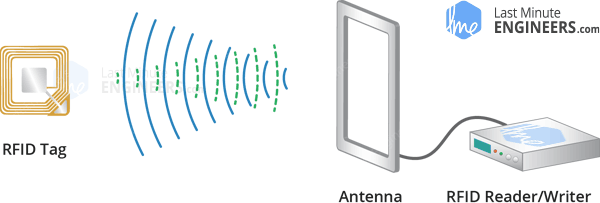
A Reader consists of a Radio Frequency module and an antenna which generates high frequency electromagnetic field. On the other hand, the tag is unremarkably a passive device, meaning it doesn't comprise a battery. Instead it contains a microchip that stores and processes information, and an antenna to receive and transmit a signal.
To read the information encoded on a tag, it is placed in shut proximity to the Reader (does not need to be within straight line-of-sight of the reader). A Reader generates an electromagnetic field which causes electrons to move through the tag'due south antenna and subsequently power the bit.
The powered chip inside the tag then responds past sending its stored information back to the reader in the class of some other radio indicate. This is called backscatter. The backscatter, or change in the electromagnetic/RF wave, is detected and interpreted past the reader which then sends the data out to a computer or microcontroller.
Hardware Overview – RC522 RFID Reader/Author Module
The RC522 RFID module based on MFRC522 IC from NXP is one of the most inexpensive RFID options that you tin can go online for less than four dollars. It usually comes with a RFID bill of fare tag and key play tricks tag having 1KB memory. And all-time of all, it can write a tag, so you tin store your some sort of secret message in it.
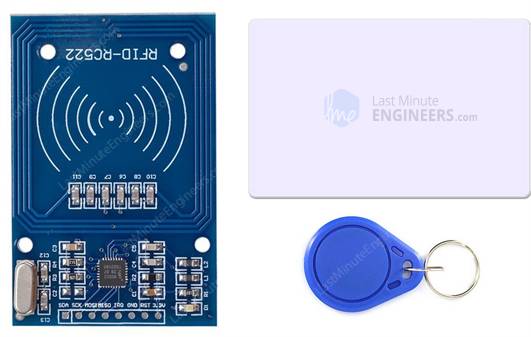
The RC522 RFID Reader module is designed to create a xiii.56MHz electromagnetic field that it uses to communicate with the RFID tags (ISO 14443A standard tags). The reader can communicate with a microcontroller over a iv-pin Serial Peripheral Interface (SPI) with a maximum data charge per unit of 10Mbps. Information technology also supports communication over I2C and UART protocols.
The module comes with an interrupt pin. Information technology is handy considering instead of constantly asking the RFID module "is at that place a card in view yet? ", the module will alert us when a tag comes into its vicinity.
The operating voltage of the module is from two.5 to 3.3V, but the good news is that the logic pins are 5-volt tolerant, so we tin can easily connect it to an Arduino or any 5V logic microcontroller without using whatsoever logic level converter.
Hither are complete specifications:
RC522 RFID Module Pinout
The RC522 module has full 8 pins that interface it to the exterior globe. The connections are as follows:
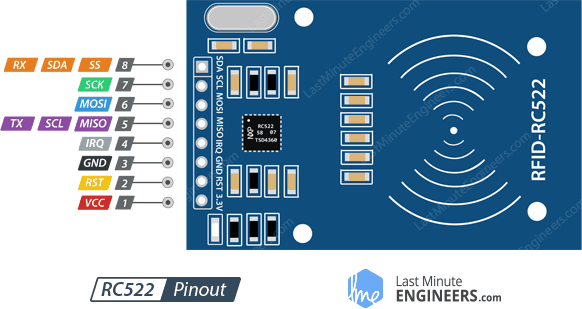
VCC supplies ability for the module. This can be anywhere from 2.5 to three.3 volts. You lot can connect it to iii.3V output from your Arduino. Retrieve connecting information technology to 5V pin volition likely destroy your module!
RST is an input for Reset and power-down. When this pin goes low, hard power-downwardly is enabled. This turns off all internal current sinks including the oscillator and the input pins are disconnected from the exterior earth. On the rising border, the module is reset.
GND is the Ground Pivot and needs to be connected to GND pin on the Arduino.
IRQ is an interrupt pin that tin can alert the microcontroller when RFID tag comes into its vicinity.
MISO / SCL / Tx pivot acts as Master-In-Slave-Out when SPI interface is enabled, acts equally serial clock when I2C interface is enabled and acts as series data output when UART interface is enabled.
MOSI (Master Out Slave In) is SPI input to the RC522 module.
SCK (Serial Clock) accepts clock pulses provided by the SPI omnibus Master i.e. Arduino.
SS / SDA / Rx pivot acts as Signal input when SPI interface is enabled, acts as serial information when I2C interface is enabled and acts every bit serial data input when UART interface is enabled. This pivot is usually marked by encasing the pin in a foursquare then it tin be used every bit a reference for identifying the other pins.
Wiring – Connecting RC522 RFID module to Arduino UNO
At present that nosotros know everything well-nigh the module, we can begin hooking information technology up to our Arduino!
To start with, connect VCC pin on the module to 3.3V on the Arduino and GND pin to ground. The pin RST can be connected to whatsoever digital pin on the Arduino. In our case, it's connected to digital pin#v. The IRQ pivot is left unconnected as the Arduino library nosotros are going to utilise doesn't support information technology.
Now nosotros are remaining with the pins that are used for SPI advice. As RC522 module require a lot of data transfer, they will give the best performance when connected up to the hardware SPI pins on a microcontroller. The hardware SPI pins are much faster than 'bit-banging' the interface code using another set of pins.
Annotation that each Arduino Board has different SPI pins which should exist connected accordingly. For Arduino boards such as the UNO/Nano V3.0 those pins are digital 13 (SCK), 12 (MISO), 11 (MOSI) and 10 (SS).
If you have a Mega, the pins are different! You'll want to use digital 50 (MISO), 51 (MOSI), 52 (SCK), and 53 (SS). Refer below tabular array for quick understanding.
In case you're using different Arduino board than mentioned in a higher place, it is advisable to cheque the Arduino official documentation before proceeding.
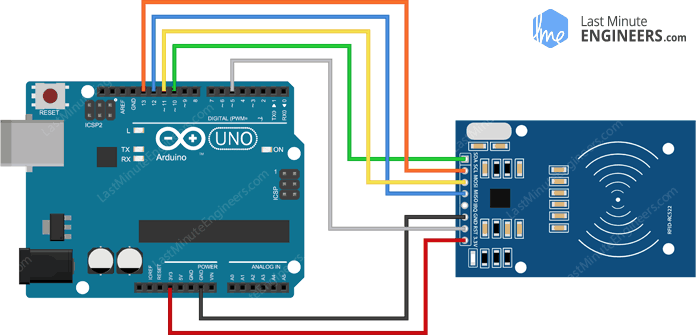
In one case you lot take everything hooked upwardly you lot are fix to go!
Arduino Lawmaking – Reading RFID Tag
Communicating with RC522 RFID module is a bunch of work, but luckily for us, at that place's a library called MFRC522 library which simplifies reading from and writing to RFID tags. Thanks to Miguel Balboa. Download the library first, past visiting the GitHub repo or, just click this push to download the null:
To install it, open the Arduino IDE, go to Sketch > Include Library > Add .Zip Library, and so select the rfid-main.zip file that y'all just downloaded. If you need more details on installing a library, visit this Installing an Arduino Library tutorial.
Once you lot have the library installed, open Examples submenu and select MFRC522 > DumpInfo example sketch.
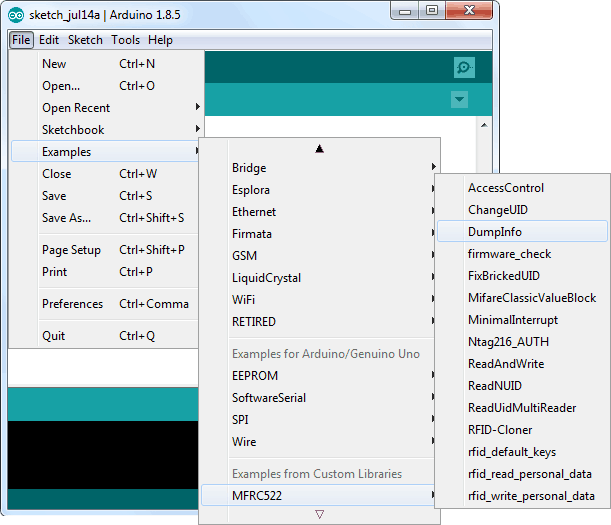
This sketch will not write any information to the tag. It just tells you if it managed to read the tag, and displays some information about information technology. This can be very useful before trying out whatever new tag!
Go to the first of the sketch and brand sure that the RST_PIN is correctly initialized, in our case we're using digital pivot #5 so modify it to 5!
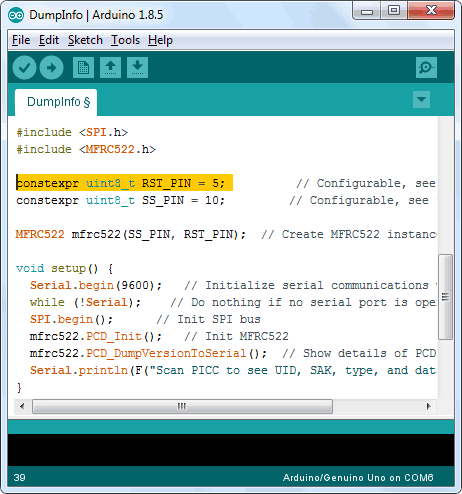
OK, now upload the sketch and open the Serial Monitor. As soon as you bring the tag closer to the module, yous'll probably become something like the following. Practise non move the tag until all the information is displayed.
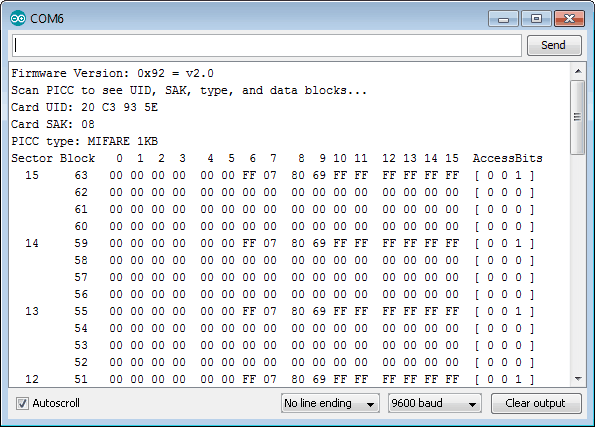
Information technology displays all the useful information about the tag including tag'southward Unique ID (UID), the retention size and the whole 1K memory.
MIFARE Archetype 1K Memory Layout
The 1K memory of the Tag is organized in 16 sectors (from 0 to 15)Each sector is further devided in to 4 blocks (cake 0 to 3).Each cake tin can shop sixteen bytes of data (from 0 to 15).
That surely tells us we accept
16 sectors x 4 blocks x 16 bytes of data = 1024 bytes = 1K memory
The whole 1K retention with sectors, blocks and data is highlighted below.
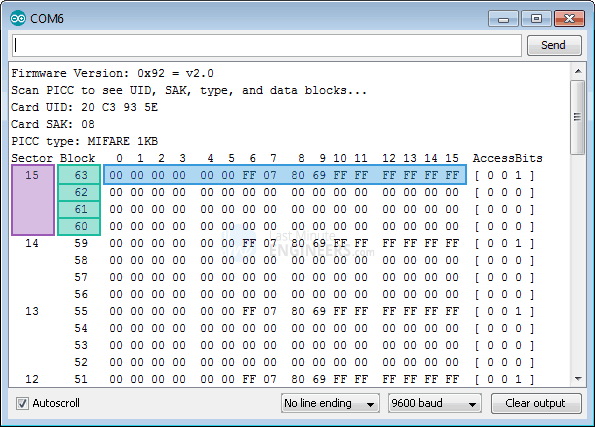

The Block 3 of each sector is called Sector Trailer and contains information called Access Bits to grant read and write access to remaining blocks in a sector. That ways only the bottom iii blocks (block 0, 1 & 2) of each sector are really available for information storage, significant we have 48 bytes per 64 byte sector available for our own use.
Also The Block 0 of sector 0 is known as Manufacturer Block/Manufacturer Information contains the IC manufacturer information, and the Unique IDentifier (UID). The Manufacturer Block is highlighted in red below.
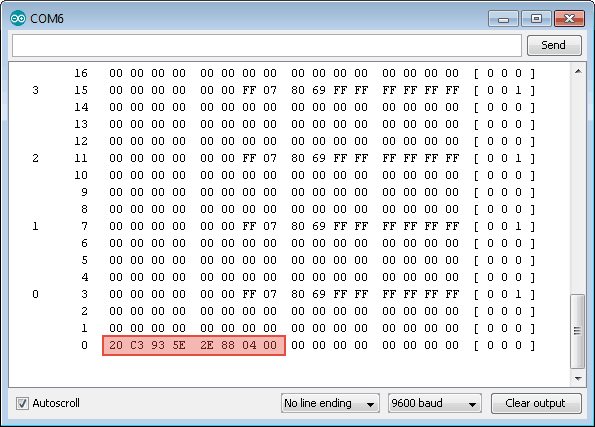
Warning:
Information technology is very risky to overwrite the Manufacturer Block and it may permanently lock the card.
Arduino Code – Writing RFID Tag
Considering you accept successfully read the RFID tag, we'll motility on to our side by side experiment. The following sketch will do a basic demonstration of writing custom data to RFID tag. Effort the sketch out, before we begin its detailed breakdown.
#include <SPI.h> //include the SPI bus library #include <MFRC522.h> //include the RFID reader library #define SS_PIN x //slave select pin #define RST_PIN five //reset pivot MFRC522 mfrc522(SS_PIN, RST_PIN); // instatiate a MFRC522 reader object. MFRC522::MIFARE_Key key; //create a MIFARE_Key struct named 'key', which will hold the card information //this is the block number we will write into and then read. int cake=two; byte blockcontent[sixteen] = {"Terminal-Minute-Engg"}; //an array with 16 bytes to be written into i of the 64 card blocks is divers //byte blockcontent[16] = {0,0,0,0,0,0,0,0,0,0,0,0,0,0,0,0}; //all zeros. This can exist used to delete a block. //This array is used for reading out a block. byte readbackblock[18]; void setup() { Serial.begin(9600); // Initialize serial communications with the PC SPI.begin(); // Init SPI bus mfrc522.PCD_Init(); // Init MFRC522 menu (in case yous wonder what PCD means: proximity coupling device) Serial.println("Scan a MIFARE Classic bill of fare"); // Ready the security key for the read and write functions. for (byte i = 0; i < half dozen; i++) { primal.keyByte[i] = 0xFF; //keyByte is defined in the "MIFARE_Key" 'struct' definition in the .h file of the library } } void loop() { // Expect for new cards if ( ! mfrc522.PICC_IsNewCardPresent()) { return; } // Select one of the cards if ( ! mfrc522.PICC_ReadCardSerial()) { return; } Serial.println("card selected"); //the blockcontent array is written into the card block writeBlock(cake, blockcontent); //read the cake back readBlock(block, readbackblock); //uncomment below line if you want to see the entire 1k memory with the block written into it. //mfrc522.PICC_DumpToSerial(&(mfrc522.uid)); //print the block contents Serial.print("read cake: "); for (int j=0 ; j<16 ; j++) { Serial.write (readbackblock[j]); } Series.println(""); } //Write specific cake int writeBlock(int blockNumber, byte arrayAddress[]) { //this makes sure that nosotros just write into data blocks. Every 4th block is a trailer cake for the access/security info. int largestModulo4Number=blockNumber/4*4; int trailerBlock=largestModulo4Number+3;//determine trailer block for the sector if (blockNumber > 2 && (blockNumber+1)%iv == 0){Series.impress(blockNumber);Serial.println(" is a trailer block:");return 2;} Serial.impress(blockNumber); Serial.println(" is a data block:"); //hallmark of the desired block for access byte status = mfrc522.PCD_Authenticate(MFRC522::PICC_CMD_MF_AUTH_KEY_A, trailerBlock, &key, &(mfrc522.uid)); if (status != MFRC522::STATUS_OK) { Serial.print("PCD_Authenticate() failed: "); Series.println(mfrc522.GetStatusCodeName(status)); render 3;//render "3" equally error message } //writing the block status = mfrc522.MIFARE_Write(blockNumber, arrayAddress, 16); //status = mfrc522.MIFARE_Write(9, value1Block, sixteen); if (status != MFRC522::STATUS_OK) { Serial.print("MIFARE_Write() failed: "); Serial.println(mfrc522.GetStatusCodeName(status)); return four;//return "iv" as fault message } Serial.println("block was written"); } //Read specific block int readBlock(int blockNumber, byte arrayAddress[]) { int largestModulo4Number=blockNumber/4*4; int trailerBlock=largestModulo4Number+3;//determine trailer block for the sector //hallmark of the desired block for access byte status = mfrc522.PCD_Authenticate(MFRC522::PICC_CMD_MF_AUTH_KEY_A, trailerBlock, &cardinal, &(mfrc522.uid)); if (condition != MFRC522::STATUS_OK) { Serial.print("PCD_Authenticate() failed (read): "); Serial.println(mfrc522.GetStatusCodeName(status)); render 3;//return "three" as error message } //reading a block byte buffersize = 18;//we need to define a variable with the read buffer size, since the MIFARE_Read method beneath needs a pointer to the variable that contains the size... status = mfrc522.MIFARE_Read(blockNumber, arrayAddress, &buffersize);//&buffersize is a arrow to the buffersize variable; MIFARE_Read requires a arrow instead of but a number if (status != MFRC522::STATUS_OK) { Series.print("MIFARE_read() failed: "); Serial.println(mfrc522.GetStatusCodeName(status)); return four;//return "4" as error message } Serial.println("block was read"); } The output on series monitor will expect like this.
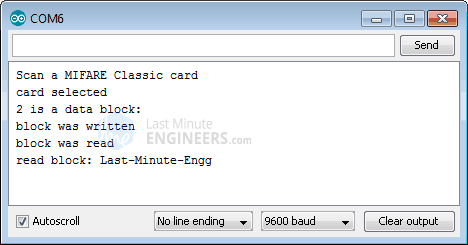
Code Explanation:
The sketch starts with including the MFRC522 and SPI library, defining Arduino pins to which RC522 is connected and instantiating MFRC522 reader object.
#include <SPI.h> //include the SPI double-decker library #include <MFRC522.h> //include the RFID reader library #define SS_PIN x //slave select pivot #ascertain RST_PIN 5 //reset pivot MFRC522 mfrc522(SS_PIN, RST_PIN); // instatiate a MFRC522 reader object. MFRC522::MIFARE_Key cardinal;//create a MIFARE_Key struct named 'central', which volition hold the card information Next, nosotros demand to define a cake in which nosotros are going to store our data. Here sector 0 cake 2 is selected. Call back never select cake 3 of any sector. Writing into 'sector trailer' cake can make the block unusable.
//this is the block number nosotros volition write into and then read. int cake=2; Adjacent, we define an array of sixteen bytes named blockcontent[16] which holds the bulletin we want to write into the block. You tin can delete any block by writing zeros.
byte blockcontent[sixteen] = {"Last-Minute-Engg"}; //an array with 16 bytes to be written into ane of the 64 card blocks is defined //byte blockcontent[sixteen] = {0,0,0,0,0,0,0,0,0,0,0,0,0,0,0,0}; //all zeros. This tin can be used to delete a block. Side by side, we demand to define an array of eighteen bytes named readbackblock[xviii]. This can be used to read the written contents back. Wait…18 bytes? Shouldn't this be 16 bytes? The respond is No. The MIFARE_Read method in MFRC522 library requires a buffer that is at least 18 bytes to agree the sixteen bytes of a block.
//This assortment is used for reading out a cake. byte readbackblock[18]; In Setup function: nosotros initialize the serial communications with the PC, SPI library and MFRC522 object. We also demand to prepare the security key for the read and write functions. Here all six key bytes are gear up to 0xFF. Since the cards in the kit are new and the keys were never defined, they are 0xFF. If we had a card that was programmed by someone else, we would need to know the key to be able to access it. This central would then need to be stored in 'key' instead.
Serial.begin(9600); // Initialize serial communications with the PC SPI.brainstorm(); // Init SPI bus mfrc522.PCD_Init(); // Init MFRC522 card (in case you wonder what PCD means: proximity coupling device) Serial.println("Scan a MIFARE Classic bill of fare"); // Set up the security cardinal for the read and write functions. for (byte i = 0; i < six; i++) { key.keyByte[i] = 0xFF; //keyByte is divers in the "MIFARE_Key" 'struct' definition in the .h file of the library } In loop function: nosotros first scan if there is a card in view, if yes, that menu is selected for writing and reading purpose.
// Expect for new cards if ( ! mfrc522.PICC_IsNewCardPresent()) { return; } // Select one of the cards if ( ! mfrc522.PICC_ReadCardSerial()) { return; } Serial.println("bill of fare selected"); Wring the block is at present very easy, nosotros only need to call a custom role called writeBlock() which takes two parameter – one is block number to which we are interested in writing the data and the information itself.
//the blockcontent assortment is written into the card cake writeBlock(cake, blockcontent); To check if the write operation was successful, we need to read the cake contents back. This can be washed using custom role called readBlock() which again takes two parameters – one is cake number and other is assortment to store block contents. You lot can use the PICC_DumpToSerial() function if y'all want to see the entire 1k memory with the cake written into information technology.
//read the cake back readBlock(block, readbackblock); //uncomment below line if you want to see the unabridged 1k memory with the block written into it. //mfrc522.PICC_DumpToSerial(&(mfrc522.uid)); Finally, nosotros print the contents of readbackblock array using a for loop and display contents on serial monitor.
//print the block contents Serial.print("read cake: "); for (int j=0 ; j<xvi ; j++) { Serial.write (readbackblock[j]); } Serial.println("");
Arduino Project
RFID Door Lock Access Control System
Let's create a quick Arduino project to demonstrate how a elementary RC522 RFID reader module tin can be used to make a RFID Door Lock Access Command Organisation. Our program will scan unique ID of each RFID tag when information technology's close enough to be energized past the RC522 reader. If the UID of the tag matches a predefined value (Master tag) that is stored in Arduino memory, the admission will be granted. And if nosotros scan any unknown tag the access will be denied. Great! Right?
This is how the output looks similar.
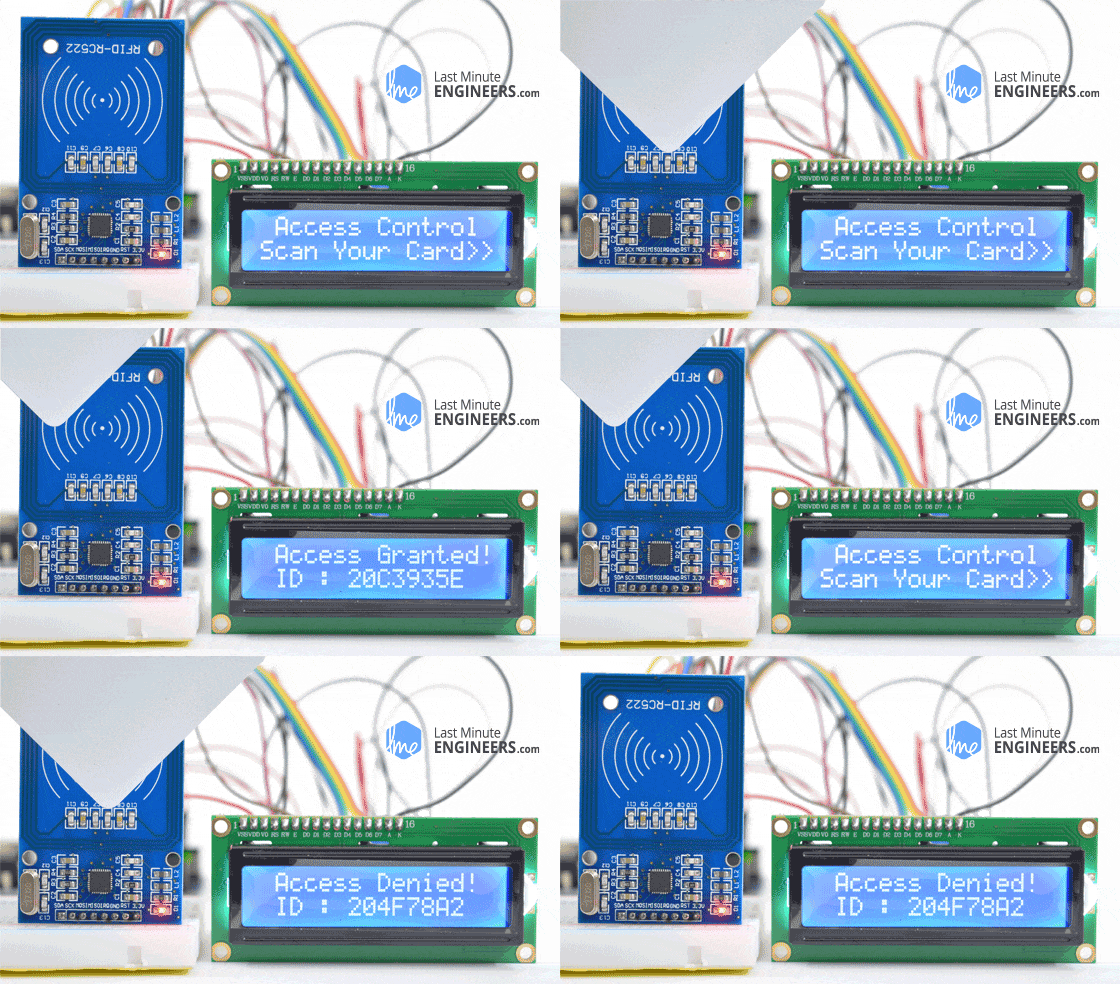
Of course this project could be interfaced to open up doors, switch on a relay, light up an LED, or anything else you can call back of.
In case you are not familiar with sixteen×2 graphic symbol LCDs, consider reading (at least skimming) below tutorial.
SUGGESTED READING

Earlier we get to uploading code and scanning tags, let'southward look at the excursion schematic for the projection.
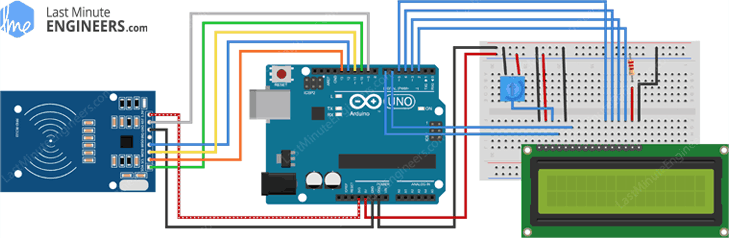
That's information technology! Now, attempt the below sketch out.
#include <SPI.h> #include <MFRC522.h> #include <LiquidCrystal.h> #ascertain RST_PIN nine #define SS_PIN x byte readCard[iv]; String MasterTag = "20C3935E"; // REPLACE this Tag ID with your Tag ID!!! String tagID = ""; // Create instances MFRC522 mfrc522(SS_PIN, RST_PIN); LiquidCrystal lcd(7, 6, 5, 4, iii, 2); //Parameters: (rs, enable, d4, d5, d6, d7) void setup() { // Initiating SPI.begin(); // SPI bus mfrc522.PCD_Init(); // MFRC522 lcd.brainstorm(xvi, 2); // LCD screen lcd.clear(); lcd.print(" Access Control "); lcd.setCursor(0, 1); lcd.print("Scan Your Card>>"); } void loop() { //Wait until new tag is available while (getID()) { lcd.clear(); lcd.setCursor(0, 0); if (tagID == MasterTag) { lcd.impress(" Access Granted!"); // You tin can write any code here like opening doors, switching on a relay, lighting up an LED, or anything else you can think of. } else { lcd.impress(" Access Denied!"); } lcd.setCursor(0, one); lcd.print(" ID : "); lcd.print(tagID); delay(2000); lcd.clear(); lcd.print(" Access Control "); lcd.setCursor(0, 1); lcd.print("Browse Your Card>>"); } } //Read new tag if available boolean getID() { // Getting set for Reading PICCs if ( ! mfrc522.PICC_IsNewCardPresent()) { //If a new PICC placed to RFID reader go along return false; } if ( ! mfrc522.PICC_ReadCardSerial()) { //Since a PICC placed get Series and go along return imitation; } tagID = ""; for ( uint8_t i = 0; i < 4; i++) { // The MIFARE PICCs that we use have 4 byte UID //readCard[i] = mfrc522.uid.uidByte[i]; tagID.concat(Cord(mfrc522.uid.uidByte[i], HEX)); // Adds the 4 bytes in a unmarried String variable } tagID.toUpperCase(); mfrc522.PICC_HaltA(); // Stop reading return true; } The program is quite uncomplicated. At the offset we include the necessary libraries, define Arduino pins, create instances of LCD & MFRC522 objects and define master tag.
#include <SPI.h> #include <MFRC522.h> #include <LiquidCrystal.h> #ascertain RST_PIN 9 #define SS_PIN 10 byte readCard[4]; String MasterTag = "20C3935E"; // REPLACE this Tag ID with your Tag ID!!! Cord tagID = ""; // Create instances MFRC522 mfrc522(SS_PIN, RST_PIN); LiquidCrystal lcd(vii, 6, 5, four, 3, ii); //Parameters: (rs, enable, d4, d5, d6, d7) In setup function, we initialize SPI interface, MFRC522 object and LCD. Following that we print welcome bulletin on the LCD.
void setup() { // Initiating SPI.brainstorm(); // SPI bus mfrc522.PCD_Init(); // MFRC522 lcd.brainstorm(16, 2); // LCD screen lcd.clear(); lcd.print(" Access Control "); lcd.setCursor(0, 1); lcd.print("Scan Your Bill of fare>>"); } In loop function, nosotros wait until the new tag is scanned. Once it's done, we compare the unknown tag with the primary tag defined prior setup office. That'southward it! If its ID matches master ID, access is granted else denied.
void loop() { //Wait until new tag is bachelor while (getID()) { lcd.clear(); lcd.setCursor(0, 0); if (tagID == MasterTag) { lcd.impress(" Access Granted!"); // You can write whatsoever code here similar opening doors, switching on a relay, lighting upward an LED, or annihilation else you lot can think of. } else { lcd.print(" Access Denied!"); } lcd.setCursor(0, 1); lcd.print(" ID : "); lcd.print(tagID); delay(2000); lcd.clear(); lcd.print(" Admission Control "); lcd.setCursor(0, 1); lcd.print("Scan Your Menu>>"); } } The fundamental thing in the projection is a custom function called getID(). Once it scans for the new card, inside a for loopit converts four byte of UID into string and concatenates to create a single string.
boolean getID() { // Getting ready for Reading PICCs if ( ! mfrc522.PICC_IsNewCardPresent()) { //If a new PICC placed to RFID reader continue render fake; } if ( ! mfrc522.PICC_ReadCardSerial()) { //Since a PICC placed get Serial and keep return false; } tagID = ""; for ( uint8_t i = 0; i < 4; i++) { // The MIFARE PICCs that we utilise have 4 byte UID //readCard[i] = mfrc522.uid.uidByte[i]; tagID.concat(String(mfrc522.uid.uidByte[i], HEX)); // Adds the iv bytes in a single String variable } tagID.toUpperCase(); mfrc522.PICC_HaltA(); // End reading return true; } Source: https://lastminuteengineers.com/how-rfid-works-rc522-arduino-tutorial/
0 Response to "Ss Motor Id Numbers How To9 Read"
Post a Comment